If you’ve been on any mountain hikes in Cumbria you’ll know that you can start out in clear weather only to learn that cloud has descended on your destination.
Sarah and I had driven to Cumbria to ascend Scafell Pike, England’s highest mountain peak, standing at 978 meters above sea level. By the time we arrived at Wasdale the surface of Wast Water was a dark, inky grey and cloud was already on Scafell Pike and Great End.
Our guide, Carol, from Lakeland Mountain Guides, met us in the carpark. She gave our outer layers the thumbs up but said three pairs of gloves would have been better than one. Then she announced the first of many warnings: There was weather on the summit. There’d be nothing for us to see up there. We might want to consider another route.
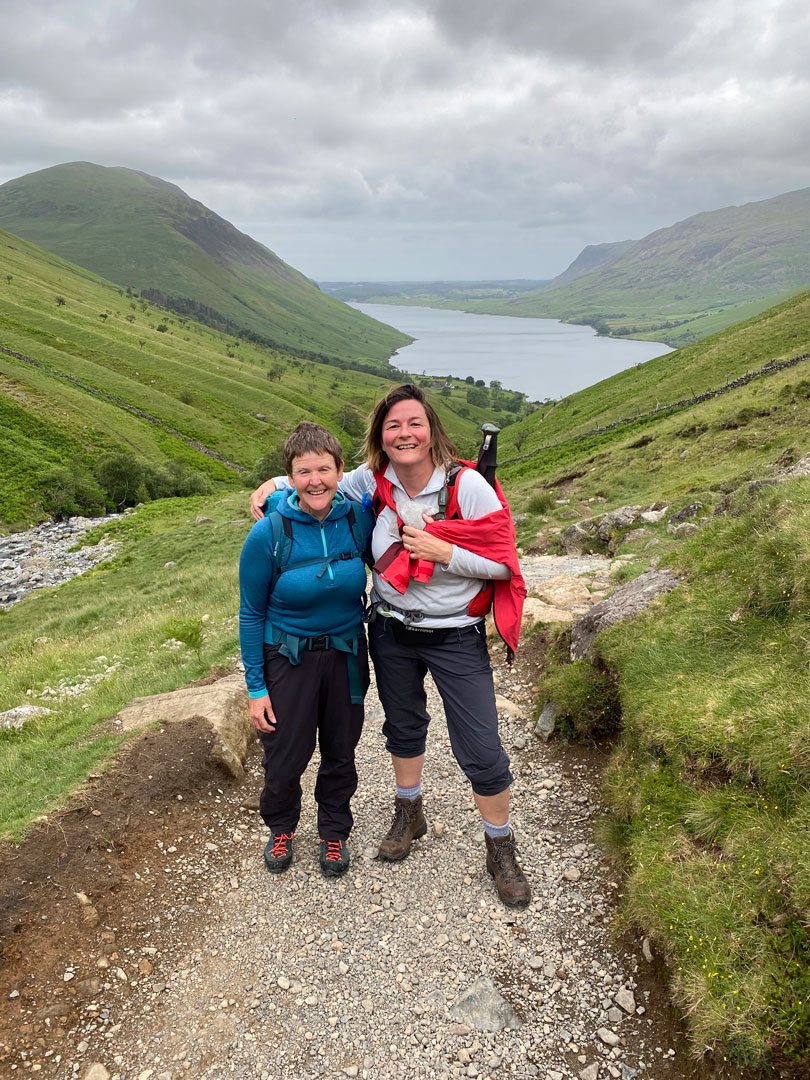
The views back to Wast Water were gorgeous. Ahead of us was another story.
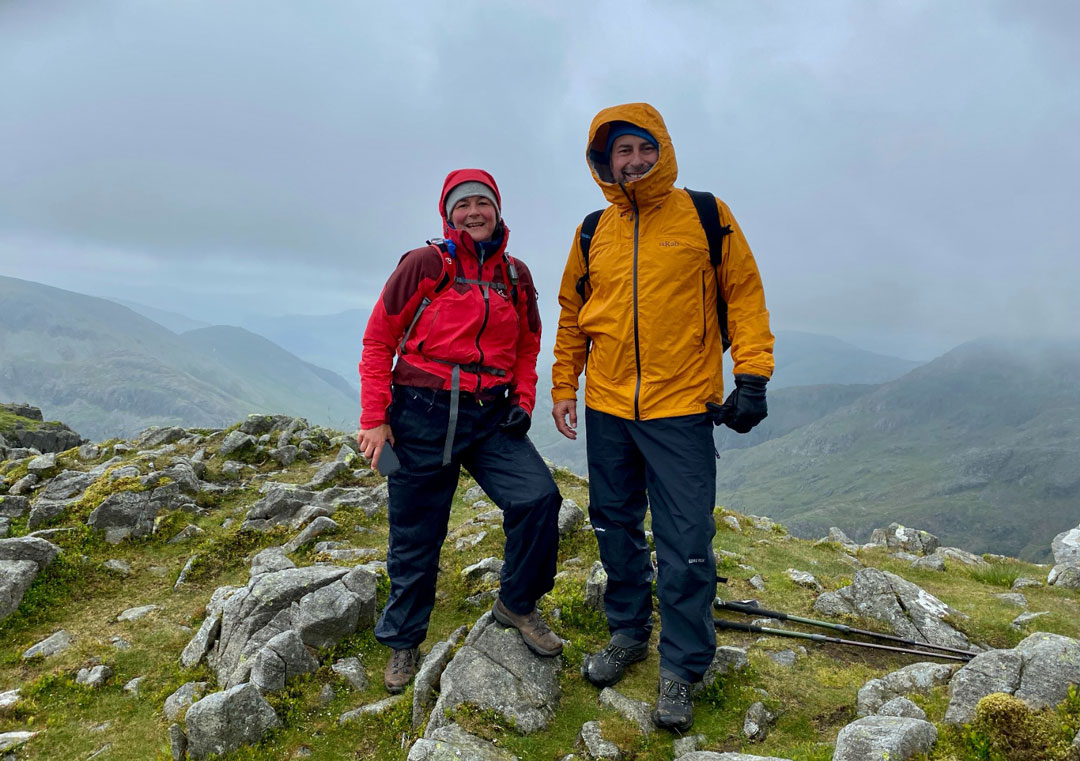
Lingmell Col, also known as The Saddle, sits at an elevation of 750 meters, and marks the gateway to the summit plateau. By the time we reached The Saddle the writing was on the wall. The cloud had dropped, as had the temperature, and we could no longer see the top of the peaks around us. It was obvious what Carol thought but the decision was ours to make. Press on for the sake of being able to say we’d reached the summit cairn. Or pivot.
It’s that moment when you’re asked to let go of something that you’ve been holding on to. To open yourself up to doing it a different way. To Carol’s relief, we chose to pivot.
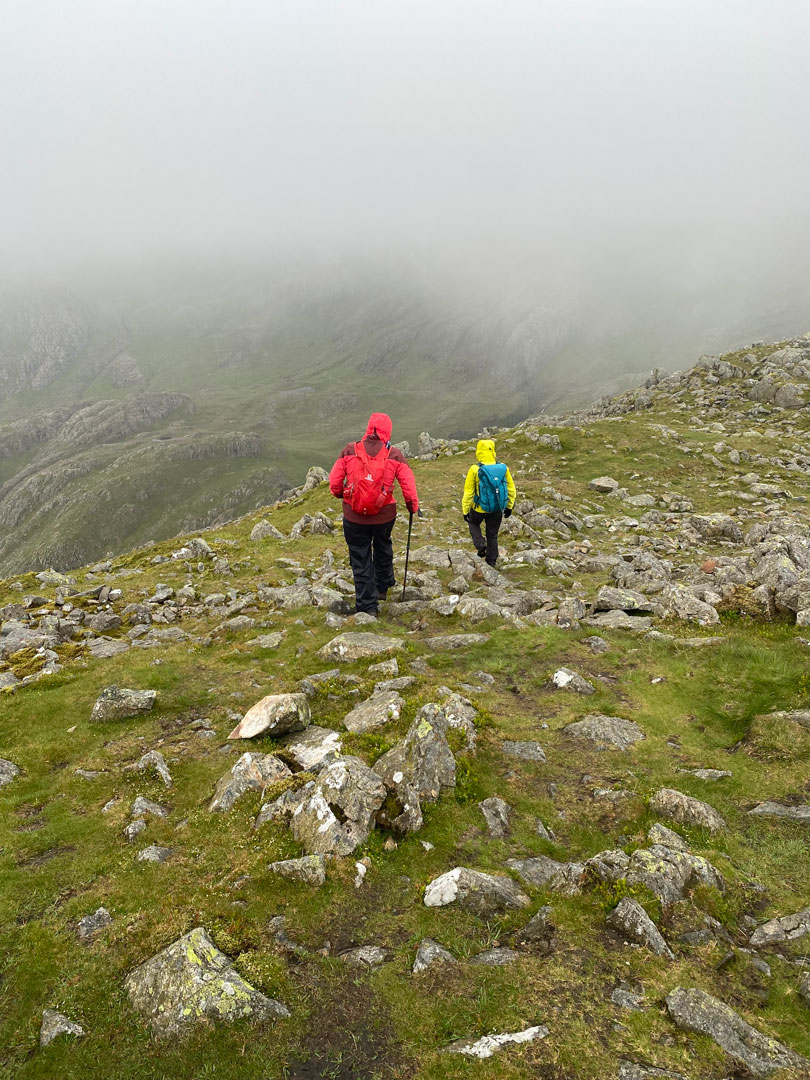
Later we would meet people who had reached the summit. They had started out from Borrowdale when the sun was shining. They wore shorts and t-shirts and were sodden and shivering. Carol was not impressed. Their story of the summit involved crawling on hands and knees in high wind and zero visibility. They located the cairn and immediately turned back, crawling in that punishing cold until they felt it safe enough to stand.
We veered left at The Saddle and wandered up to the summit cairn of Lingmell, our highest point at 807 meters above sea level. The rock was spotted with lime green lichen and the view across that great yawning valley to Styhead Tarn and beyond was breath-taking.
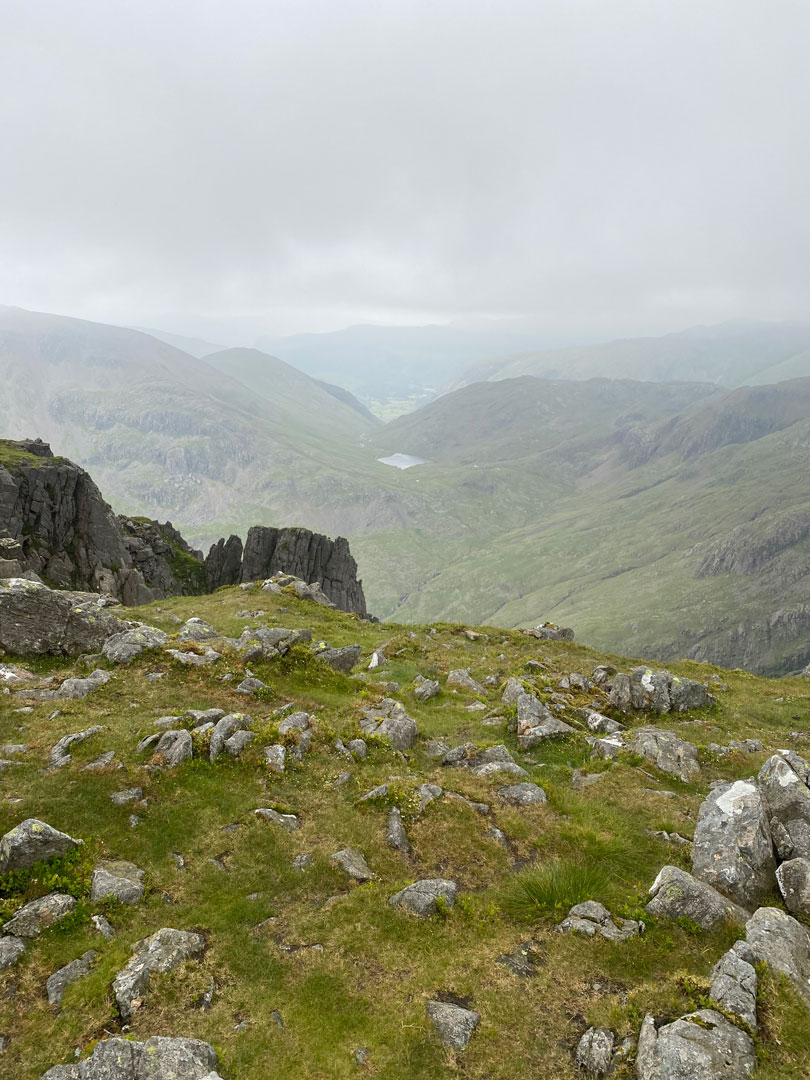
We dropped back to The Saddle as the cloud descended further and the rain set in. Carol guided us on to the Corridor Route, that would take us towards Styhead Tarn. When we reached Piers Gill my jaw hit the floor. It’s a dramatic, deep-cut ravine, made up of a series of hazardous waterfall climbing pitches, that breaks the northern face of Lingmell. From here I could see across this tear in the land to the slopes of Kirk Fell and Great Gable.
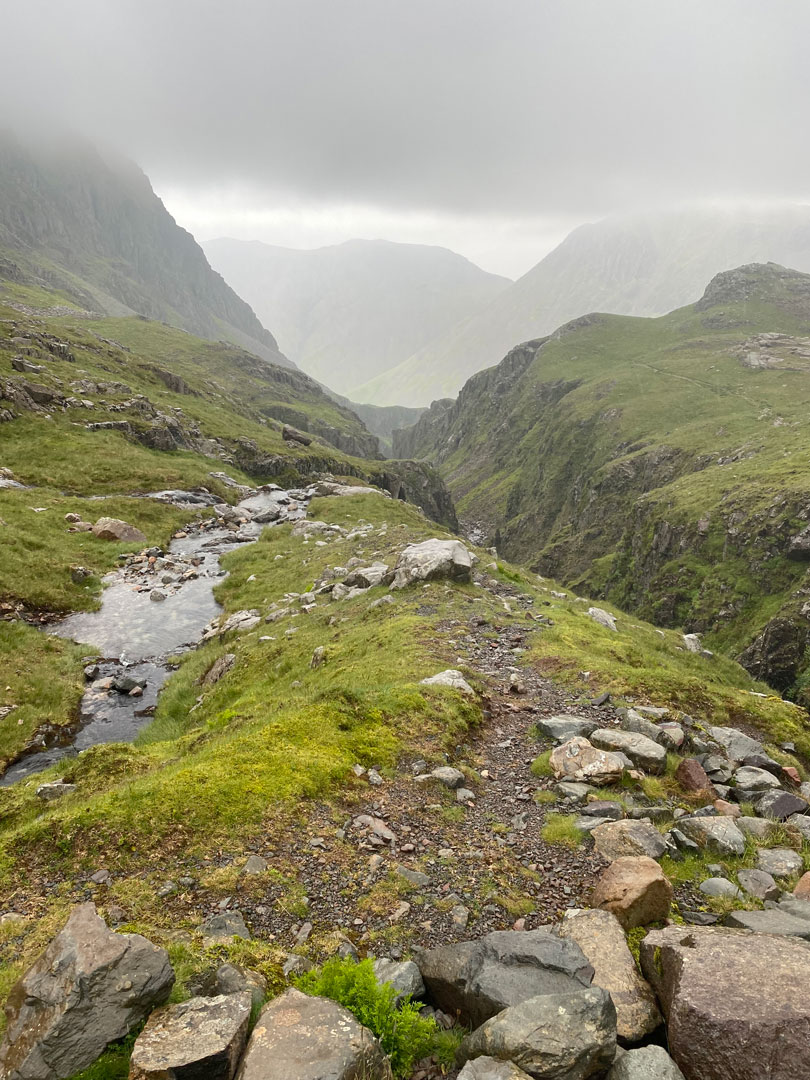
Having now taken in the views from Lingmell and Piers Gill I was convinced our decision to pivot had been the right thing to do. We just needed to trust our instincts. Change things up. Embrace the unknown. All we’d needed was a little push. Thanks, Carol!
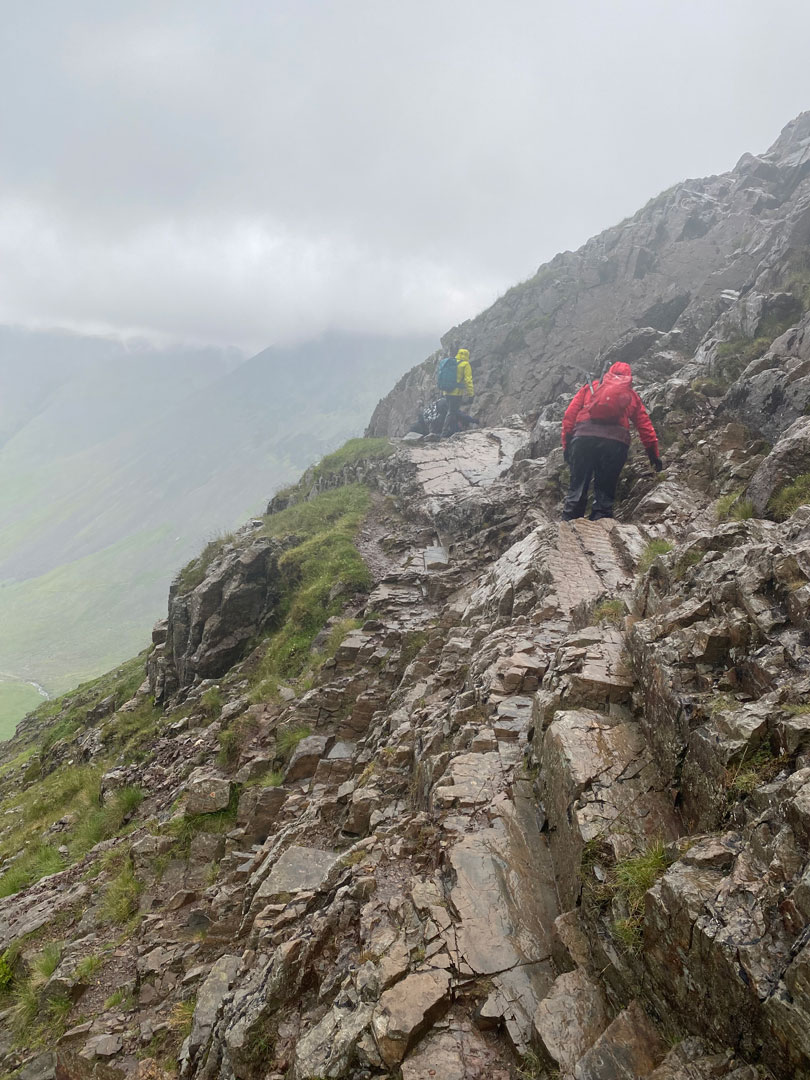
I can picture myself on that trail skirting the vertiginous edge of the Corridor Route in a cold and relentless rain. Ahead is my guide. She walks the same path that I do. Yet, it is left up to me to navigate the waterlogged ruts that cut across the track and boulders to be scrambled over or traversed to reach our destination. I can trust in my ability to forge ahead in the knowledge that my guide will be there if I go wrong. It’s a lot like coaching.
It was here, wedged between the towering flanks of Great End and Great Gable, that I became fully aware my problems had completely fallen away and all that mattered was what was happening right now, in this very moment. In this incredible space where landscape, movement, and guide intersect. And it was here that I began to reflect on the appeal of pairing coaching with the power of movement. It was from this thought that my coaching journey began.
I’ve since witnessed how my coaching clients react to landscape and movement whenever we walk around a park or along a stretch of beach. I’ve observed how their pace might slow down or stop when they reflect on a question I’ve asked. I’ve observed how simply standing beside them can reinforce feelings of safety and trust. And I lean into stillness as a way of grounding and focusing my client through their moments of deep reflection.
The remainder of our mountain hike will see us scramble over a tongue of rock, cross the boggy flat at Styhead Tarn, and then navigate loose rock along the old smugglers route below Napes Needle until we dropped down to the stone-walled fields in the Wasdale valley. It was a cracking day. Choosing to pivot instead of doggedly forging ahead was the best decision. I will never forget those views across ancient rock. And I’m grateful to the weather that forced our hand and put me on the path of the Corridor Route and the path to becoming a coach. The only thing I would change? Next time I’ll pack three pairs of gloves.