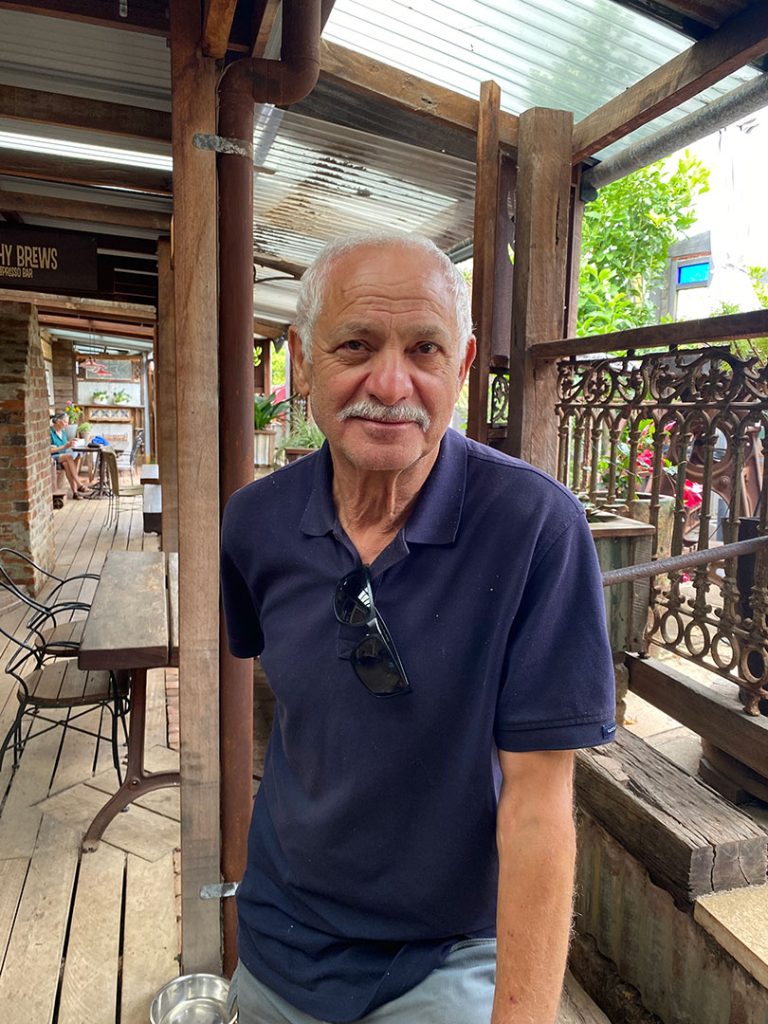
“I’ve developed an affinity for old buildings,” Sam tells me, as he leans back in his ironwork chair, beside the weatherboard exterior of The Witch and Windmill.
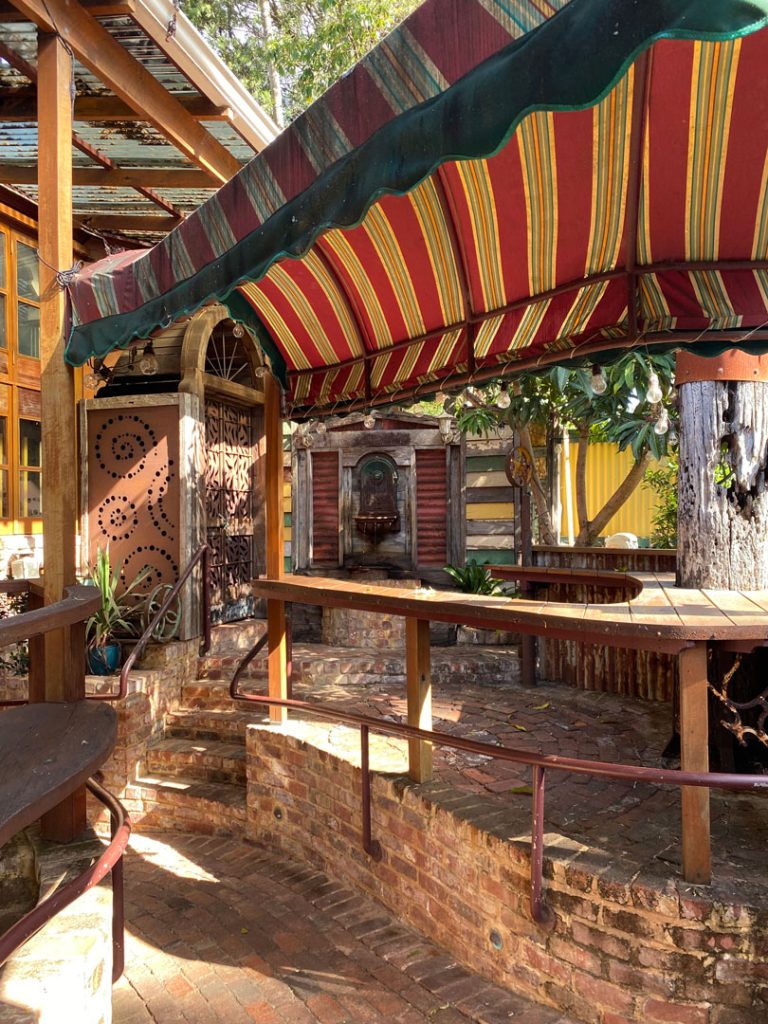
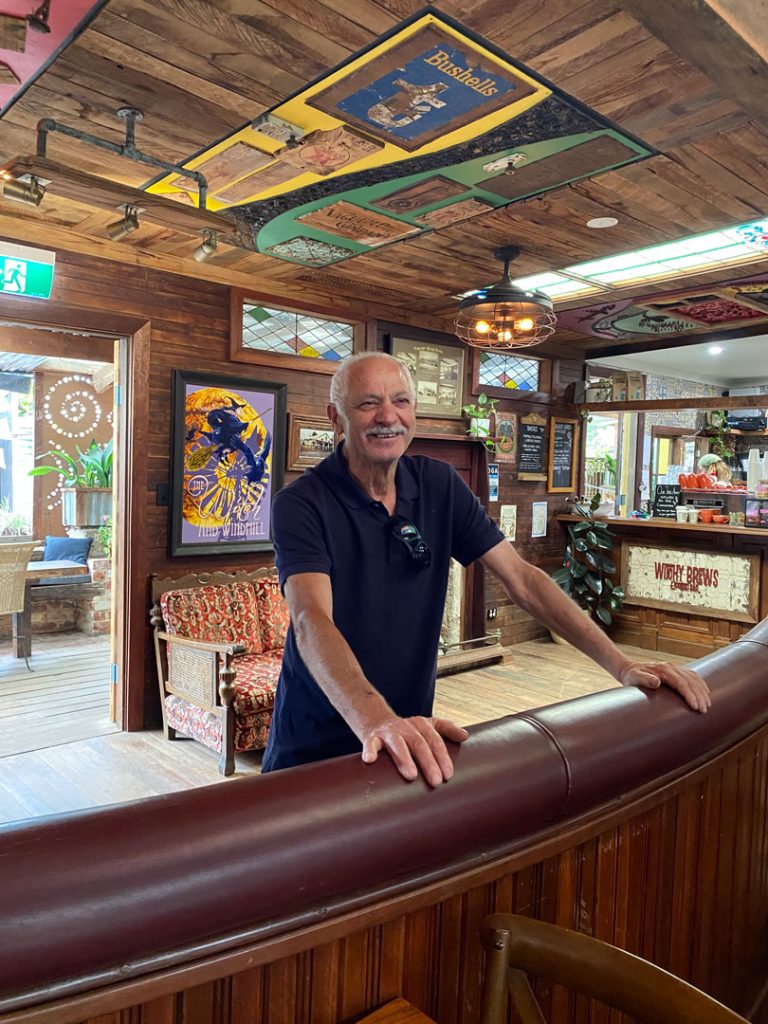
The Witch and Windmill is a century-old building that was once Darnell’s General Store and Post Office, built c1927. Sam breathed life into the space using his signature style of piecing together heritage and salvaged materials. The Witch and Windmill now houses the cellar door of winemakers Amato Vino, the Witchy Brews coffee bar, The Marri Tree – an art, books and music space, and foodie destination, Dear Darnell’s. Out the back, on what was a bare block, stands The Chapel Witchcliffe, which Sam built himself, brick by brick.
Other spaces displaying his unique touch include Adamsons Riverside, Bridgefield Guesthouse, La Scarpetta Trattoria, and Pizzica Italian Restaurant in Margaret River.
You can hear the reverence in his voice as he talks about each space that he’s put his heart and soul into, particularly his most recent project, The Witch and Windmill, which began life as a shell of a building –a place that had been stripped back to its bones.
It makes you understand that this isn’t simply about restoration.
It’s encompasses Sam’s appreciation a building’s heritage, the roots of its history, and how it sits within the heart and consciousness of the local community. It’s also about Sam’s own past, his memories of a landscape lost, and his response to the forests of the South West.
AC: How do you decide what a bare space will develop into?
SC: Organically, would be the word. It just evolves. I might have an overall vision but that changes as you go. Originally this was going to be a space for artists in residence.
AC: You use rejected and reclaimed materials. How do you decide what goes where?
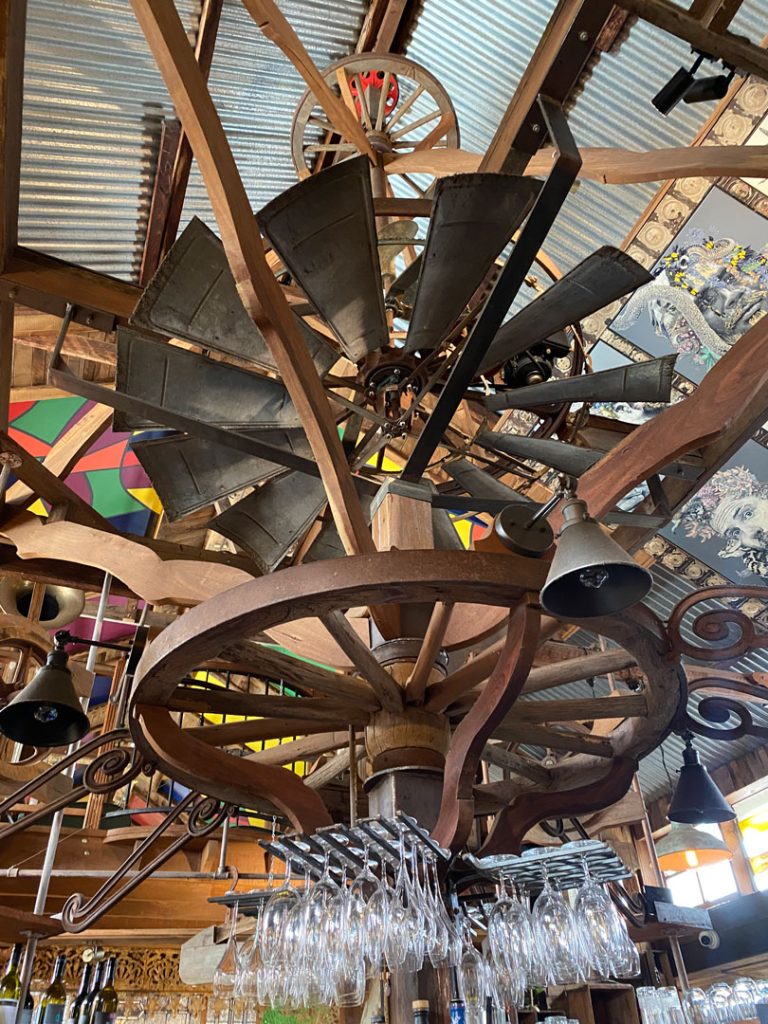
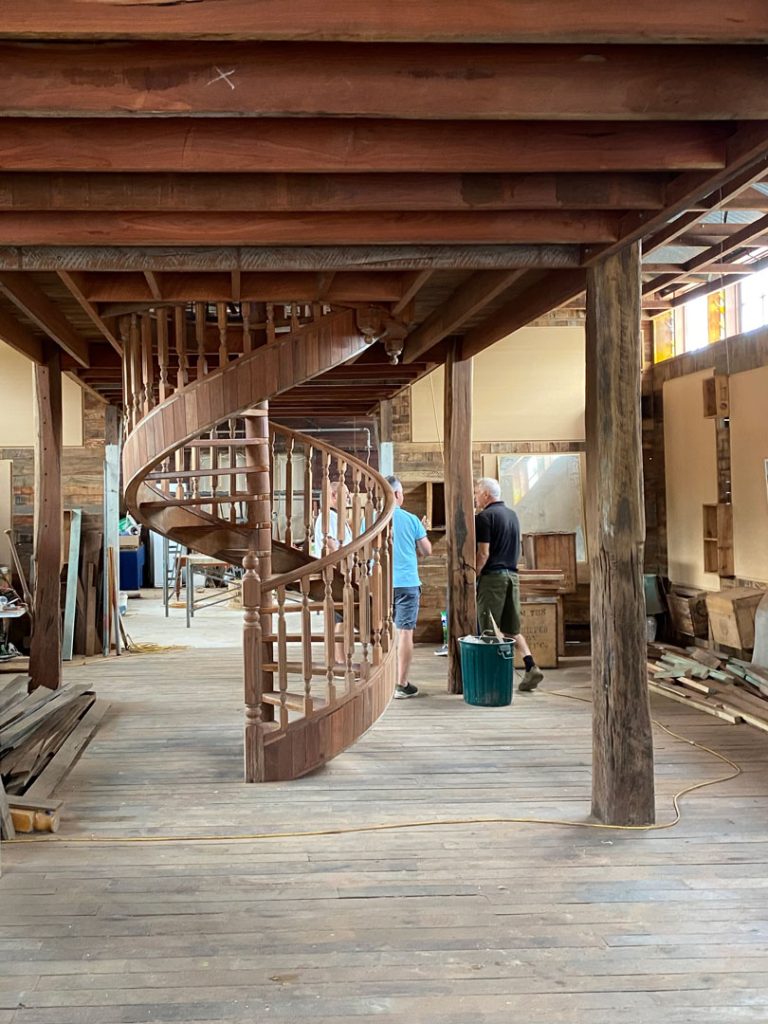
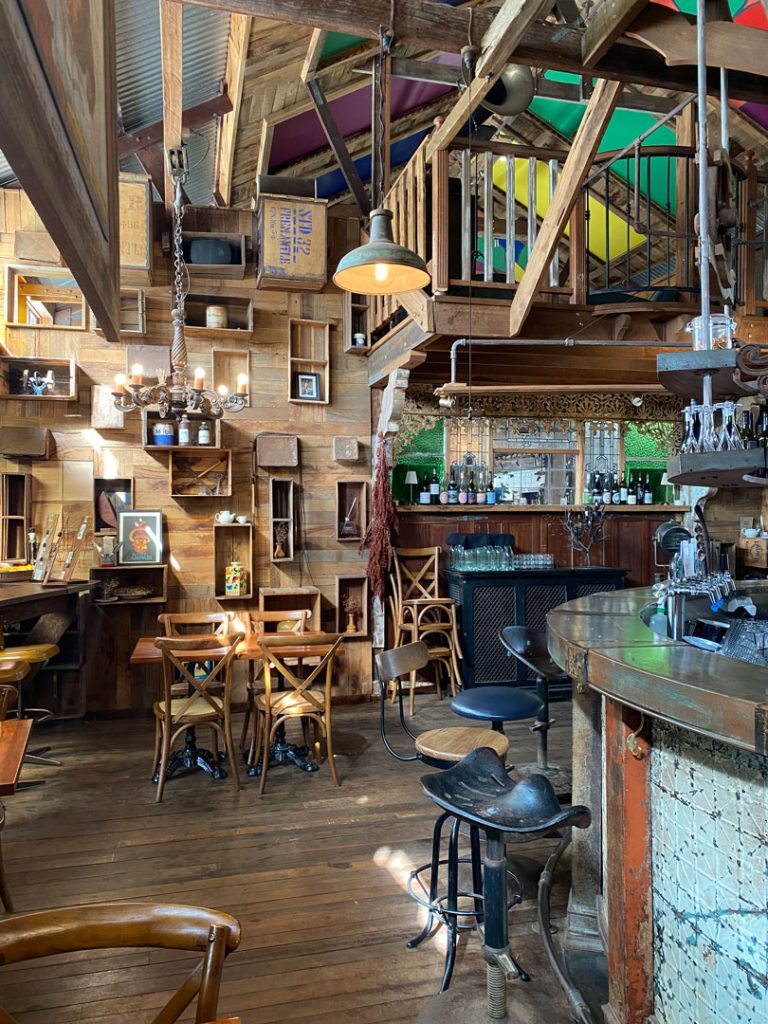
SC: This place has so much height, so I thought, why don’t I make a mezzanine floor, because I had a jarrah spiral staircase that I’d picked up in a salvage yard. I wanted a circular bar but I wasn’t sure of how I was going to construct it. I had some pressed tin and cast iron downpipes. So I used the old pipes as columns around the bar and I put the pressed tin panels in between. I had an old windmill from a farm around here. A guy from Bridgetown Windmills happened to walk in and I asked him if he could make a fan out of a windmill and a couple of old wagon wheels. He made the framework for it and the motor and I rigged it up myself. It’s a bit noisy but it works.
AC: How long did The Witch and Windmill take to complete?
SC: Seven years. Other than the electrics and plumbing I did the work myself, with help from a young guy, Simon. I did it in my own time but I don’t really have any other interests. This place has been the most challenging because it was in such bad condition. The amount of work that needed to be done was phenomenal. For most people it would have been too daunting to attempt.
AC: How would you describe the work you do?
SC: I’m a peasant carpenter. I’m a tradesman with a rustic vision. I cobble things together and that seems to work. A guy once said to me, it’s a lot of junk put together but it looks good.
AC: Pizzica in Margaret River didn’t start as an existing space. How did it come about?
SC: The first building was built by pioneers as a stagecoach stop and guest house. It was re-built in 1931 and it’s been standing there since on these rotten jarrah stumps. I’d opened La Scarpetta and the floor used to bounce when the waiters walked across the restaurant. The stumps needed to be replaced. I had a crazy idea. If I dig down deep enough could I create some storage for the restaurant upstairs? And then I thought, how far would I have to dig if I wanted to build another restaurant down there? I dug out about 300 square meters of soil. It was a hell of a job.
AC: Where does your passion for old buildings come from?
SC: It probably comes from my childhood. I was living in these old, stone buildings in Sicily. In Australia it was a different thing. Here it was weatherboard and iron. Shacks, really, but they had character. I guess I developed, over the years, a bit of an affinity for them.
AC: How does your life in Sicily and Australia compare?
SC: We were from Provincia di Messina. Sant’Angelo di Brolo, Ficarra and Sinagra, in that area. When you’re living in mountain villages, you only go down to the town centre if you want a haircut or you need to see the doctor. Otherwise you’re living in the bush. As a child I was among trees. I was in the countryside. My father came out in’53 and we came out in ’62. I turned eleven on the ship a few days before reaching Fremantle. Coming to Perth was exciting. It was a very harsh existence in Sicily and I thought Australia has got to be better than this. I didn’t even know my father because there’d been a nine year gap. But when he used to take me to Kalamunda and Gooseberry Hill in the hills, I used to think this looks like home. I thought it was like Sicily.
AC: When did you first come to Margaret River?
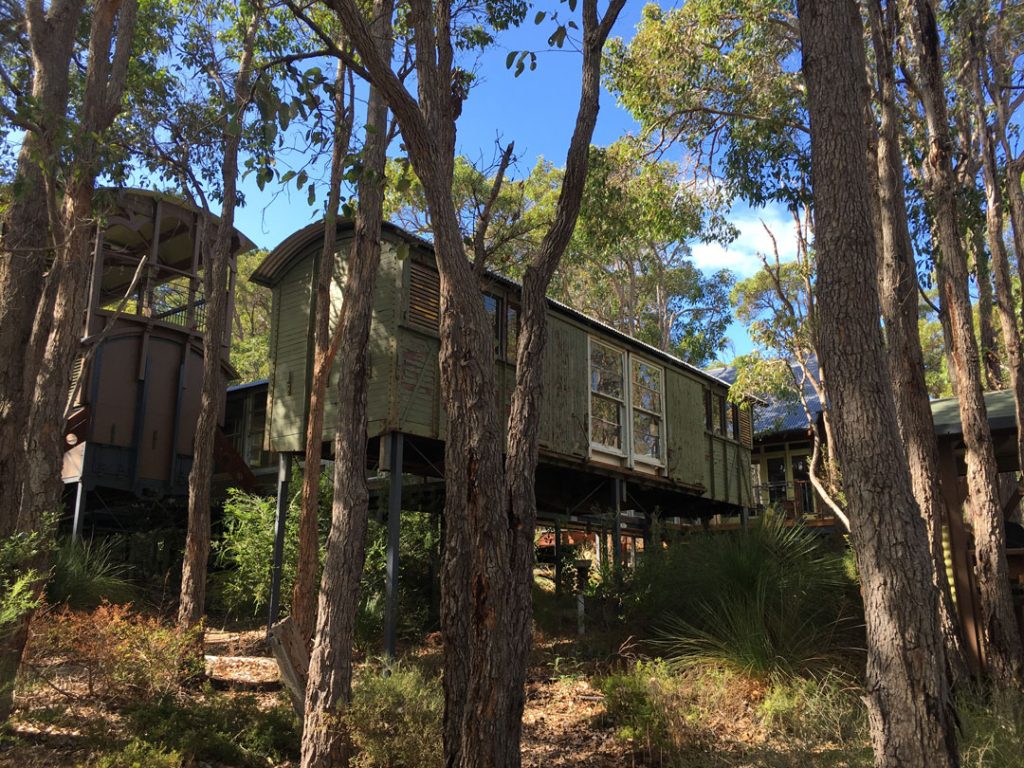
SC: Nearly twenty two years ago. I was always fascinated by the South West. It reminded me of my childhood, of being among trees. There were small tress in Sicily. Mainly Chestnuts, birch, oak, that sort of thing. Not like what you have here in the South West. My idea was to buy a bush block and put a railway carriage on it to use as a place to stay on weekends. I found the railway carriage. Then I thought, what if I built the whole place out of railway carriages? So then I sourced five carriages from the Sunday Times Readers Mart.
AC: Where does your love of working with wood come from?
SC: In high school I did manual arts. I preferred working with wood. It got my passion going. I’ve been using wood all my life. Jarrah and Marri and Blackbutt. Mainly recycled and a lot of it is seconds, or rejects. I find that there’s so much waste in Australia. Luckily they’ve stopped logging the native forests. You’ve got to preserve what’s left. The old jarrah railway sleepers, which I’ve used here, is not premium timber but they do the job. These were all rejects. You don’t have to have premium wood to make something look good. They’re still quite beautiful as far as I’m concerned. And I come from that era when we just ‘made do’. My mother was always trying to fix things the best she could. There’s always been that tradition, you make do with what you’ve got. That’s what I thought when I first saw this building in Witchcliffe.
AC: Where do you think your creativity comes from?
SC: Well, I suppose it’s always been there. I guess it’s in everyone to a certain extent. It’s finding what you are good at. I couldn’t afford to buy a brand new house at the time so I started finding old houses. Dilapidated houses that had character and I brought them back to life. I did it on the side while running my cabinet-making business. And I developed an affinity for old buildings.
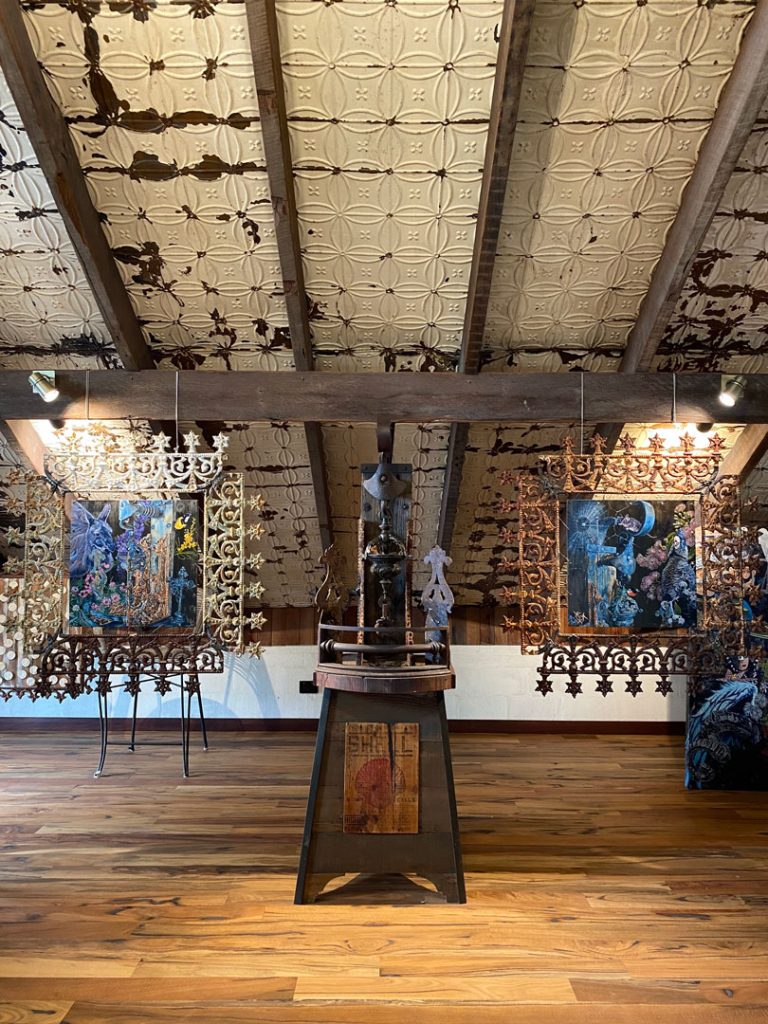
Rural Utopias was a major contemporary art exhibition co-produced by the Art Gallery of Western Australia (AGWA) and the arts organization SPACED. It featured new works by 10 national and local artists who completed residencies in remote and regional WA between 2019 and 2023. Jackie Cheng, whose residency was in Margaret River, collaborated with Sam and artist Nigel Smith to create an installation in response to The Witch and Windmill in Witchcliffe. It was exhibited alongside Altarpiece: Alter ego by Nigel Smith and a sculpture titled Forged in toil this mortal coil by Salvatore Caruso. Does Sam view his work as artistic?
SC: I’m not an artist. I was asked to make something that represents me and this area. I looked through the bits and pieces I’d collected and cobbled it together and I made the sculpture. Nigel did a couple of paintings. I had iron filigree lacework that used to be on verandas and I used it to frame the paintings. Now, they are both displayed upstairs in the chapel.
AC: Which space has been your favourite?
SC: This one because it’s an iconic building and it was such a challenge. It’s been the most interesting and the most satisfying and I’ve done something for the community by putting the soul back into the place. I feel like I’ve done something positive.
AC: Do these spaces become personal to you?
SC: I’m not attached. I’m becoming less attached, anyway. You realise that nothing is permanent in this world. My feeling is I’ve done it now. I’ve left my legacy.
AC: How has aged impacted your passion for work?
SC: When I was building the chapel I was feeling short of breath and I thought that my time had come. I had only just started the brickwork. I thought, who is going to finish this place? Who will know how to do the stained-glass windows? I thought, no one will finish it how I want. Well, I came good. There were days when I felt overwhelmed but I just pushed through it. I’m very grateful that I can still do things.
AC: What’s next now that The Witch and Windmill is finished?
SC: I’m beyond retirement age for most people but I would love to get into something else. I’d like to expand this place. It’s a dream, in a way. I’ve got to be realistic. I enjoy doing it but I’d need to rely on other people to do the physical work. I’m excited about buildings. I have a passion for these old weatherboard and iron places. And I’m always look for opportunities.